Energy management systems: A structured approach to unlocking the full potential of energy efficiency


Since 2019, Énergir and Hydro-Québec have been offering their industrial clients a program to support the implementation of an energy management system (EMS). Renewed in 2026, the program now offers enhanced grants, clearer guidelines and closer alignment with the ISO 50001 standard.
What Is an Energy Management System?
An energy management system, or EMS, is a structured, systematic process built on the implementation of measures, tools and continuous improvement strategies for energy performance. This process drives behavioural and operational changes at all levels of the organization to increase energy efficiency and reduce waste. “Take a plant where operators follow different practices from one shift to the next, causing energy consumption to vary depending on the team. With an EMS, measures are put in place to standardize best practices and minimize energy consumption,” says Donald Beverly, an engineer with Énergir's DATECH group.
Tangible Benefits
A cornerstone of any energy efficiency portfolio, an EMS can generate recurring energy savings of 3 to 6%, with little to no upfront investment. These savings not only reduce energy costs—they also become a source of revenue. Under Énergir’s program, every cubic metre of natural gas avoided and verified by a monitoring report qualifies for a grant of $0.50.1
The Importance of Leadership
Because an EMS involves structural change, senior management must demonstrate leadership from the outset. A clear commitment helps overcome the natural resistance to change that comes with implementing an EMS. Management must develop and communicate a clear, specific and measurable energy policy that will be central to both its commitment and the EMS itself. Leadership also means allocating the time and resources needed to carry the project through. “When employees understand the goal of an EMS and have the tools to make the changes expected of them, things become much easier,” says Donald Beverly.
Continuous Optimization Through Data
As the saying goes, “If you can’t measure it, you can’t improve it.” An EMS therefore entails the continuous collection of operational data to evaluate and progressively improve facility energy performance. Collected through meters, flow meters, sensors and other measurement devices, this data is stored in an energy management information system (EMIS) and analyzed to identify opportunities for improvement. An EMS is therefore a powerful information platform that facilitates energy management decision-making and enables operators to establish and implement best practices in real time. The knowledge gained, measures put in place and data collected are critical assets that can help a company stand out from the competition through its energy performance, while building resilience against external factors.
A Long-Term Project
Unlike some other energy efficiency initiatives, deploying an EMS is a multi-year undertaking.
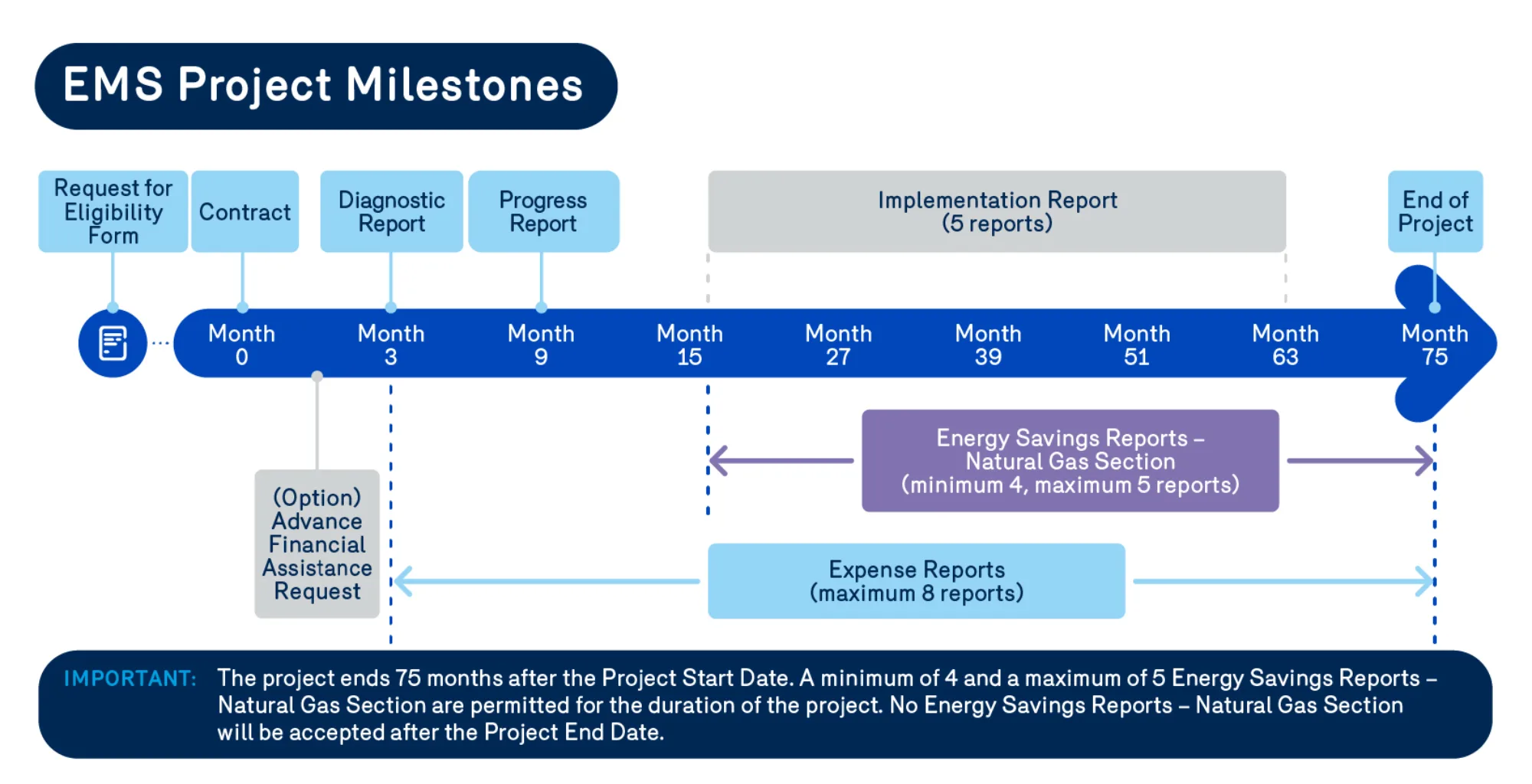
If a client is ready to commit to the process, the first step is signing a commitment agreement, which confirms their understanding of everything an EMS entails and Énergir’s commitment to providing the financial and technical resources the program offers.
The second step is establishing an energy profile of the company by examining its energy management practices, identifying its energy savings potential and defining the general parameters for EMS implementation. “This profile gives us a clear picture of the company’s energy situation and lays the groundwork for EMS deployment,” says Beverly.
From there, EMS implementation can begin—a process that typically unfolds over several years (see key steps below). Success depends on a number of key ingredients:
- Sustained commitment and involvement from senior management
- An energy management awareness and training program at all levels of the organization
- The appointment of an energy champion
- The establishment of an energy management committee
- An energy management information system (EMIS)
Stakeholder Engagement: An Essential Component
The success of a continuous improvement project is also closely tied to stakeholder engagement. This engagement involves:
- A clear understanding of the project’s benefits for the organization
- A clear definition of the concrete objectives to be achieved
- Explanations of how each individual and team can contribute to meeting those objectives
- Regular communication of results and opportunities for improvement
While senior management’s influence is key to conveying project objectives and benefits at a high level, the energy champion and energy management committee are responsible for ensuring that everyone involved in the EMS actively contributes to the project, as well as communicating results to allstakeholders.
Opex vs. Capex
“ One of the main strengths of an EMS is the implementation of small, incremental changes that, when combined, help reduce energy bills for less money than traditional energy efficiency measures, which involve equipment purchases and often costly implementation. What’s more, the 2026 renewal of the EMS support program is structured around ISO 50001 certification—an internationally recognized energy management standard. Participating in Énergir’s program will therefore greatly streamline the certification process. ”
Tangible, Lasting Benefits
While deploying an EMS reduces energy intensity and carbon footprint, the benefits don’t stop there:
- Integrated into a company’s practices, an EMS is a robust, lasting system that will endure regardless of staff turnover.
- It enables the company to report its sustainability and environmental results to industry peers and clients.
- It improves engineering practices: new capital projects will be required to demonstrate their impact on energy consumption and outline measures to improve their efficiency.
- It facilitates the sharing of information with clients, legislative and regulatory authorities, and suppliers.
- It allows companies to require better energy performance from service providers’ equipment and systems.
- It helps strengthen the company’s competitiveness and its reputation for environmental sustainability.
Technical Support and Financial Assistance
Aware of the potential of an EMS, many companies have already taken steps to implement the process with Énergir’s support. Énergir and Hydro-Québec work together to support these companies on both the technical and financial fronts. Énergir guides companies through every step of the process and offers grants at each major stage of EMS implementation: diagnosis, development and implementation, and savings monitoring. As Philippe Rivard notes, “our grant application process is aligned with Hydro-Québec’s, which simplifies things considerably.”
To learn more about the support Énergir offers.
For case studies on companies that have implemented an EMS:
Legal notice
1. $0.50 per m3 of natural gas saved over a five (5) year period, up to a maximum of $1 million.
Further reading

Painting line optimization achieves savings of 55%
Based in Saint-Jean-sur-Richelieu, Termaco manufactures medium- and large-size welded p...
Combined heat and power, a natural gas technology with high potential
Since the 19th century, combined heat and power (CHP) technology has been producing ele...
Natural gas: An asset in remote areas
Extending the gas network to all of Québec’s spheres of economic activity is no mean fe...
Renewable natural gas, a circular economy model
Renewable natural gas production not only presents a significant economic development p...