
Recovering heat from effluent: Another effective solution for reducing energy bills and greenhouse gas emissions


Effluent heat recovery is a promising yet still little-known energy efficiency solution. In this article, we’ll present four concrete applications of this solution and the technologies used in each case, as well as the potential and challenges involved in making its use more widespread.
A renewable energy source to be tapped
Much like exhaust air, wastewater is a significant source of recoverable heat. Recovering this thermal waste can reduce energy costs across residential, commercial, industrial and institutional environments—even at the scale of an entire neighbourhood.
Drain water heat recovery: A simple and affordable technology
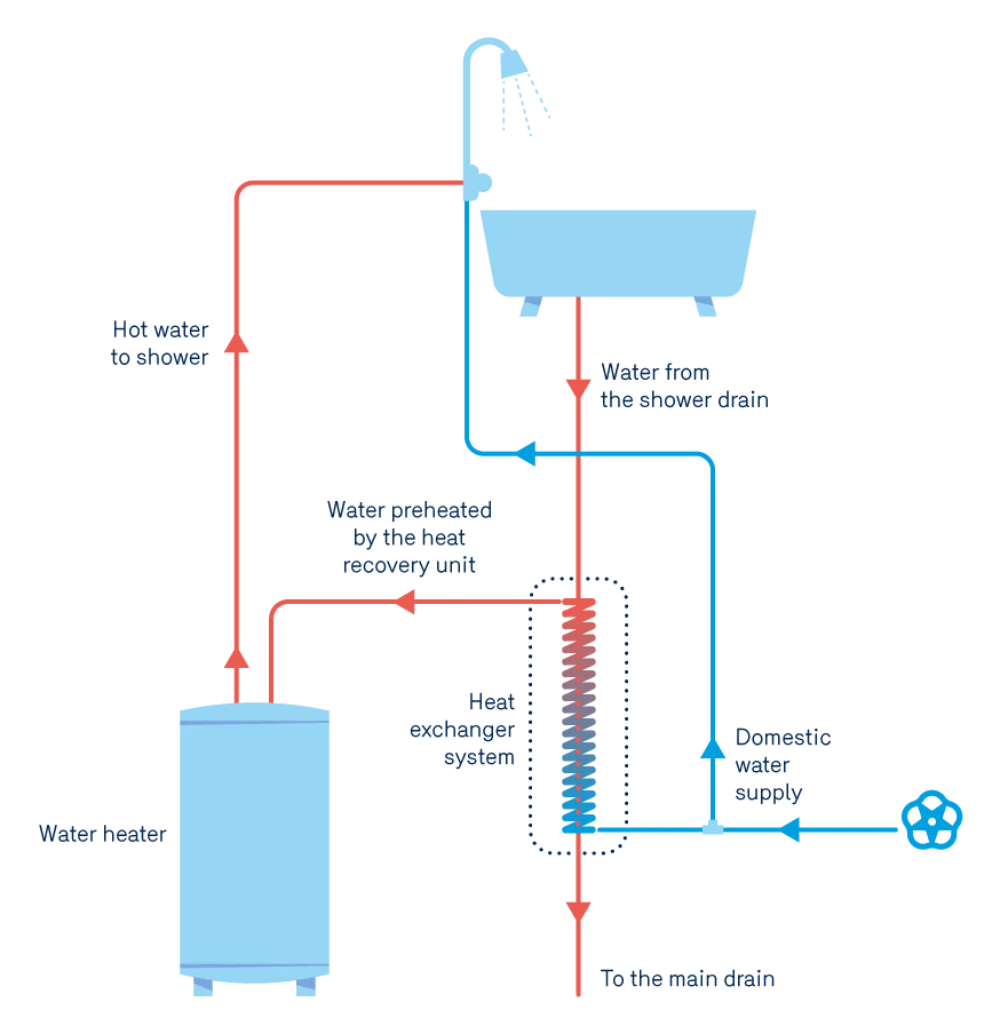
Drain water heat recovery (DWHR) is a particularly interesting technology for homeowners. Once used for showering, hand washing, laundry or dishwashing, domestic hot water is usually discharged into the sewers via the drains of the house or building. A DWHR system recovers some of the heat lost down the drain2 using coils attached to the building’s drain stack. These coils preheat the incoming (cold) water supplying the water heater, without ever mixing with the wastewater. This simple and proven system offers several advantages:3
- 10% to 40% reduction in domestic hot water heating costs
- Return on investment period of 6 to 8 years
- Service life of 30 to 50 years
Domestic hot water heating represents 15% to 25% of the energy bill for Canadian households.4
Innovative Quebec technologies for the multi-residential sector
DWHR remains largely untapped in the multi-residential sector, but several innovations could change the game in the years to come. This is notably the case for technologies developed by RegenEAU and Aquartis, two Quebec companies specializing in water treatment and wastewater heat recovery.
RegenEAU
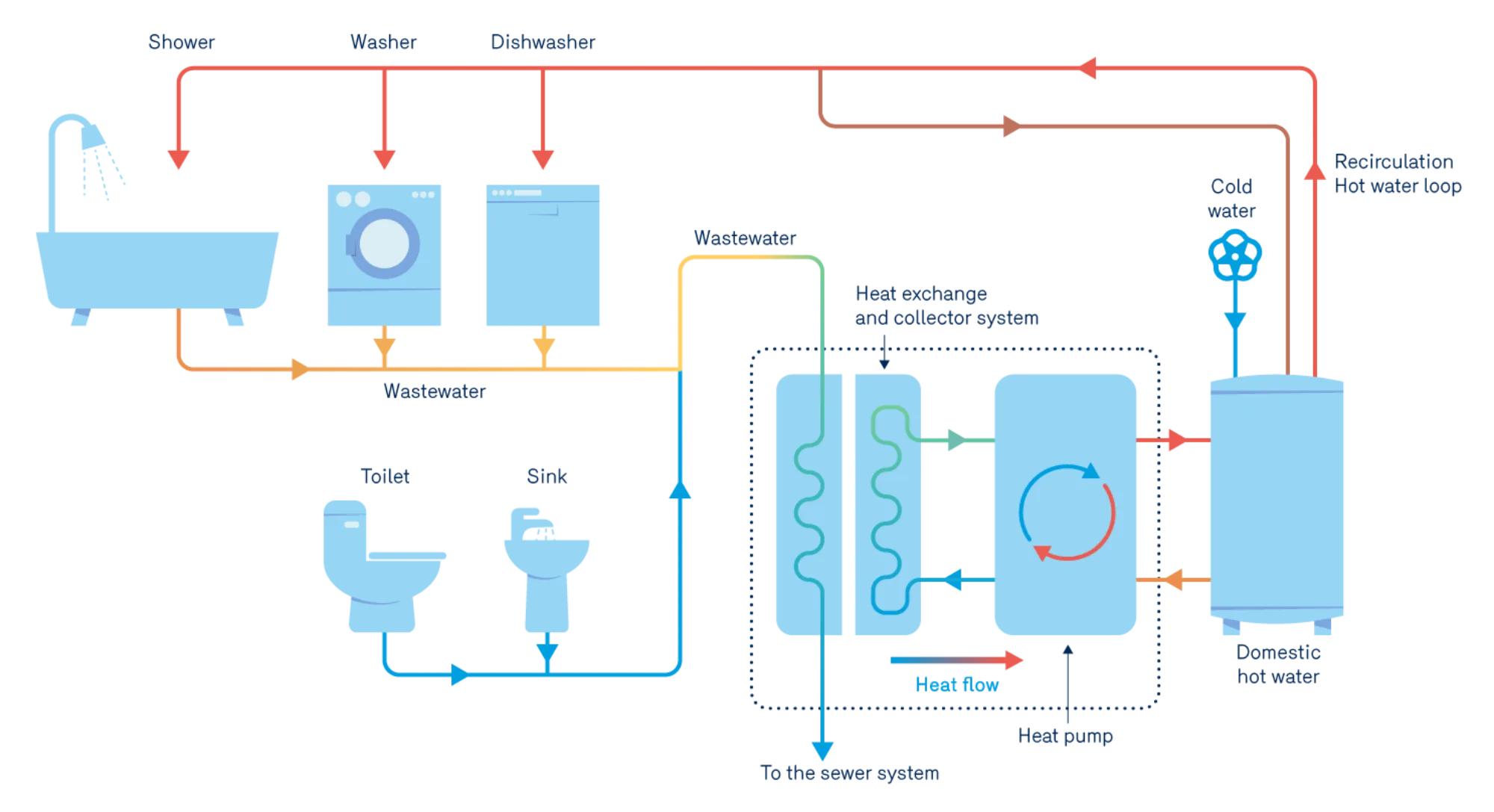
Under the leadership of its CEO, David Pineault, RegenEAU has developed a modular wastewater heat recovery system (for greywater and blackwater) based on a patented process for separating solids and liquids. The water filtered through this process is stored in a tank where the residual heat is recovered by a heat pump to be kept until it is used, while the residual wastewater is sent to the sewers. This system reduces energy consumption by preheating hot water5 and requires little maintenance. In 2024, Bild, a real estate developer in the Québec area, was the first in the country to deploy RegenEAU’s technology in a 42-unit multi-residential building. Two other RegenEAU systems are also being integrated into an existing 145-unit building in Sainte-Foy, near Québec. They are expected to cut energy use by 46% compared to the baseline scenario.6
Aquartis
Aquartis, a water recycling company founded in 2010, recently developed a new automated wastewater treatment system called TritonTM that recovers heat from wastewater to preheat domestic hot water and reuse some of that water for toilets and irrigation. In 2025, this system was first deployed to a new 48-unit building managed by Les Habitations l’Équerre, a non-profit organization in the Sherbrooke region. The projected results are promising, with an expected 40% drop in water consumption and a 70% decrease in the energy required to produce domestic hot water. Learn more: https://tinyurl.com/yf4wyfp9
Recovering waste heat from municipal pipes: A winning urban strategy
In Vancouver
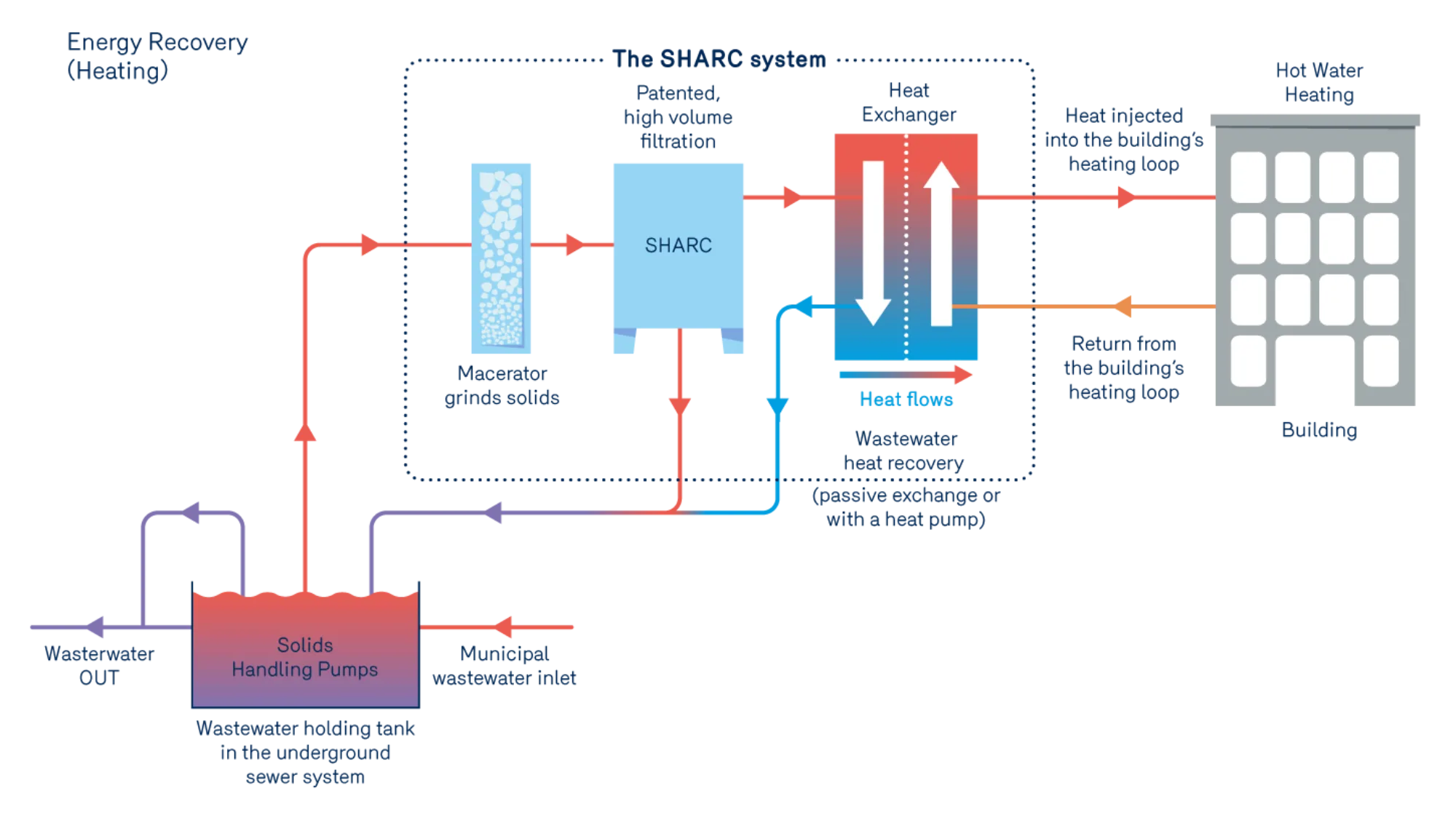
Wastewater heat recovery can also be done on a larger scale, as is the case with the False Creek Neighbourhood Energy Utility in Vancouver, British Columbia. Based on Wastewater Energy Transfer (WET), technology developed by Vancouver-based SHARC Energy, this loop captures heat from sewage. The water is first filtered to separate solids from liquids, then pumped through heat exchangers to generate energy for heating or cooling buildings in the sector. The pumped wastewater is then returned to the municipal sewer system. The False Creek WET system serves more than 1,900,000 square metres of residential, commercial and institutional buildings. By preventing the release of approximately 4,400 tonnes of GHGs per year, it’s currently the largest of its kind in North America.
In Toronto
A similar system is being installed at Toronto Western Hospital, a healthcare facility in the heart of the city. Developed by Noventa Energy, the system will capture heat from wastewater using a wet well approximately 50 m deep. Located directly under the hospital and connected to the municipal sewer system, it’s coupled with heat exchangers and chillers/heat pumps. It’s estimated that this system will save the facility $700,000 annually in heating and cooling costs and reduce its GHG emissions by 8,400 tonnes per year.
In Ottawa
At the same time, other wastewater heat recovery projects integrated into neighbourhood energy loops are emerging or in development across Canada and the United States. One example is the LeBreton Community Utility project in Ottawa, which will use energy captured from sewage to heat the 608 homes in the Odenak complex and prevent more than 5,000 tonnes of GHG emissions.7
In Quebec
According to our research, there are currently no municipal sewer heat recovery projects in operation in Quebec. A study was conducted for Énergir Urban Heating and Cooling (ECCU) to evaluate the feasibility of capturing energy from the sewers adjacent to its plant on Robert-Bourassa Boulevard in Montréal. The plant supplies over two million m2 of buildings with hot water, steam and air conditioning. However, while the measure remains attractive, the water flow was deemed too low to make such a system cost-effective in the short term.
By using sewage heat recovery systems Toronto Western Hospital is expected to save $700,000 per year in heating and cooling costs.
Sewage heat recovery: A new breakthrough in wastewater heat recovery
Sewage heat recovery involves installing heat exchangers in a municipality’s wastewater treatment tank to draw energy directly from the wastewater. The water in the treatment tank transfers its heat to a heat transfer fluid, which is then routed to a heat pump. The pump raises the temperature to provide heating or cooling for one or more buildings. In Canada, the first project of its kind was launched in 2022 at the Équipe Laurence headquarters in Sainte-Adèle. Since then, the results have convinced the City of Prévost to use this technology to heat its future sports complex, which is slated to open in summer 2026.
Process water heat recovery: Another tool for industrial decarbonization
Among other possible applications, recovering heat from process effluent or “waste” hot water is a particularly compelling option. It involves harnessing the energy in the effluent of industries with significant hot water needs (pulp and paper, agrifood, metallurgy, textiles, etc.) to preheat water or air for internal or external use, reducing energy costs and GHG emissions.
One example is the Launrec RTB system from Sofame Technologies, a heat recovery unit designed for laundries and dye works. This system has been deployed at Les Textiles Coraltex Inc., a Montréal-based manufacturer of high-end textiles. It saves more than 300,000 m3 of natural gas annually—yielding a 64% energy reduction compared to the process water heating requirements prior to the measure’s implementation. Several other manufacturers, including Ellis Ludell and Kemco, market comparable systems. Using shell-and-tube heat exchangers, they recover heat using a counter-flow process, allowing for heat exchange with a 5°F approach temperature. The success of these solutions depends on filtering the particles upstream of the exchanger.
The RheX system, from Italian manufacturer Pozzi Leopoldo, offers a different approach: heat exchange occurs through a series of lenticular discs mounted on a rotating hollow shaft that transfers energy from the process water to clean cold water. The constant movement of the discs uses gravity to clear the process water of any matter. This system can treat very dirty water without requiring upstream filters and provides constant thermal efficiency.
Process water heat recovery has allowed Les Textiles Coraltex Inc. to reduce the energy needed for its process water heating by 64%.
Data centre heat recovery: A booming technology
In recent years, recovering waste heat from data centres and computing facilities has gained momentum in Quebec and around the world. The growing adoption of immersion cooling systems for this type of waste heat is radically transforming the potential for waste heat recovery. In these facilities, the heat emitted by electronic equipment is transferred to water-cooled systems. Although the hot water produced is not an effluent, the heat it carries is still thermal waste that must be removed.
Rather than dissipating this energy into the environment, it can be recovered to heat buildings or neighbourhood thermal loops. The Humano District project in Sherbrooke is a perfect example: the Exaion data centre was designed to be integrated directly into the site, in the mechanical room of the former convent. This feeds the energy loop of the real estate development and optimizes the use of the heat produced.
A number of Quebec companies also offer thermal recovery solutions adapted to smaller facilities, particularly in the building sector, including FirstBlock, Hypertec and Datanergie. FirstBlock, for example, markets solutions for multi-unit residential and commercial buildings with heating capacities generally ranging between 50 and 100 kW at temperatures reaching up to 60°C. This allows heat recovery to be integrated into urban and real estate contexts for domestic hot water production.
Economic and environmental potential…
The examples presented in this article show that recovering heat from effluent, regardless of its source, can lead to savings and a smaller carbon footprint at an individual level. They also highlight the potential added value of this solution when integrated into a neighbourhood energy loop or coupled with other renewable energy sources, such as geothermal energy or heat recovery from exhaust air, where it can amplify economic and environmental gains. The Goverment of Quebec has published a map of waste heat and thermal needs (agriculture, the environment and natural resources). This map, which geolocates all potential emitting and consuming sites in the province, is designed as a decision-making tool for managers and developers of waste heat recovery projects.
…and challenges
For effluent heat recovery projects to succeed, a number of factors must be taken into consideration:
- Load balancing (flow/temperature vs. needs) is required to optimize energy reduction:
- In some cases, buffer tanks must be included in the system design.
- In most designs, because the water temperature is not high enough, heat pumps must be integrated into the heat recovery system.
- Liquid/solid separation must occur before heat exchange so the system functions properly and to prevent exchangers from fouling.
- The heat source (resource) must be located near the site with energy needs, ideally within 500 m for large-scale deployment, particularly within a neighbourhood energy loop.
Énergir supports your energy efficiency projects
Through the Effective Diagnosis and Implementation component of its energy efficiency program, Énergir offers grants8 of up to $50,000 for a feasibility study and up to $1,000,000 for the implementation of a wastewater heat recovery project that reduces natural gas consumption. To learn more about this topic, find out the program’s terms and eligibility criteria and get support for your project, if available, contact an Énergir energy solutions advisor at 1-833-835-1313 or by filling out this form.
Special thanks
I would like to thank Guy Pelletier, from Fintex, for sharing his expertise on the industrial sector.
Mélissa Théorêt
Senior Advisor, Energy expertise
Notes
1 Provided there’s no change in consumption habits.
2 The DWHR system must comply with CSA B55.1 and B55.2 standards and have a drain water heat recovery efficiency rate of at least 42%.
3 Source: https://www.ecohabitation.com/guides/2549/les-recuperateurs-de-chaleur-des-eaux-grises-ce-quil-faut-retenir/
4 Source: Natural Resources Canada, Water Heater Guide, p. 3 (accessed at https://NaturalResources.ca/sites/nrcan/files/energy/pdf/energystar/WaterHeaterGuide_e.pdf)
5 According to the Regeneau product brochure: https://regeneau.com/wp content/uploads/2022/06/Depliant_RegenEAU.pdf
6 That is, the energy consumption of the same building without the Regeneau systems.
7 Compared to traditional buildings using boilers and chillers.
8 Certain conditions apply. For grant program terms and conditions and eligibility criteria, visit this page. The amounts and terms and conditions of available grants are subject to change without notice.
Further reading
Energy management systems: A structured approach to unlocking the full potential of energy efficiency
Since 2019, Énergir and Hydro-Québec have been offering their industrial clients a prog...
Lassonde improves energy performance through heat recovery
Lassonde Industries Inc. is a leader in the food and beverage industry in North America...
Bridgestone’s Joliette Plant Sets an Example for Decarbonization
Bridgestone, a global tire manufacturing giant, has set itself the goal of becoming an ...

Shawinigan Aluminium: Innovation for sustainable aluminum production
Shawinigan Aluminium (SAI), operator of the cast house at the former Rio Tinto Alcan pl...