
Collège Bourget: Dual energy driving decarbonization


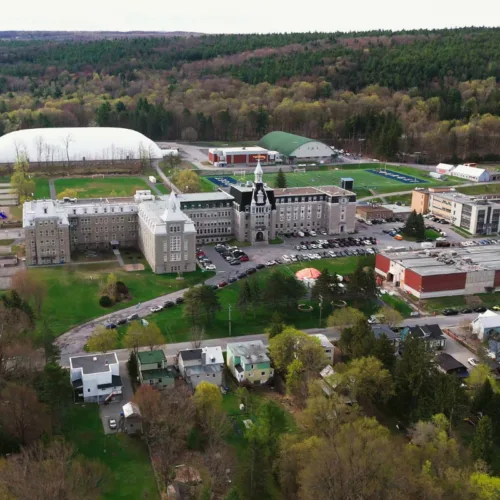
Collège Bourget, a private educational institution located in Rigaud, Montérégie, has been engaged in an energy transition process since 2022. It launched a major decarbonization project in 2024–2025. The initiative involved a number of stakeholders, including Énergir, and was based on implementing a dual-energy system combined with various energy efficiency measures. These solutions are expected to enable the institution to reduce its greenhouse gas (GHG) emissions by 87% and lower its annual energy costs by 12%1.
Innovative financing
Given the scale of the project and its potential cost, Collège Bourget’s management team first turned to SOFIAC, a financing solution that invests in, develops and manages major energy efficiency projects. Through an innovative financing model that requires no upfront investment from the client and is repaid through the savings generated, the College was able to access the funding required to implement its project.
An experienced partner
SOFIAC then partnered with C-nergie, an energy efficiency firm now part of the E’nergys group, to serve as the project manager. “We had already worked with SOFIAC on a similar initiative at Collège Jean de la Mennais in 2022, and that experience allowed us to strengthen our expertise and build a relationship of trust with SOFIAC,” explains Dany Houde, engineer and project lead for Collège Bourget at E’nergys.
Dual energy at the heart of the project
From the outset, it became clear that dual energy would play a central role in the project: both the College’s management team and the E’nergys team were seeking innovative solutions that could significantly reduce the institution’s emissions. “When Pierre-Olivier Nadeau from Énergir’s DATECH team contacted us to discuss the project after visiting the College, it became clear that dual energy could be the cornerstone of this initiative given its tremendous decarbonization potential,” says Dany Houde.
Énergir: Supporting and facilitating
The detailed feasibility study conducted by E’nergys in 2024 helped refine how the proposed solutions would be implemented and led the DATECH team to play an important support role for the E’nergys team. “The commercial and institutional (CI) dual-energy program had just been launched, and we wanted to understand what was and wasn’t feasible with this solution. Pierre-Olivier really helped us see things more clearly and confirmed our assumptions about the program,” says Dany Houde.
Accelerating the project’s return on investment
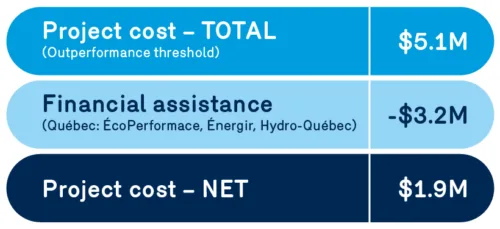
This collaboration also helped optimize Énergir’s financial incentives for a number of the proposed energy efficiency solutions as well as for the addition of a new natural gas water heater for domestic hot water. In total, Énergir provided more than $200,0002 in grants to support Collège Bourget’s decarbonization project. This funding was combined with financial assistance from the Quebec government through the EcoPerformance program and from Hydro-Québec to nearly halve the project’s return on investment period, reducing it from 16.2 years to 8.5 years.
An integrated and optimized solution
The technical solution implemented by E’nergys combines a series of key measures that will enable Collège Bourget to make a significant shift toward the energy transition while substantially reducing its reliance on fossil fuels.
1- Optimizing heating water production
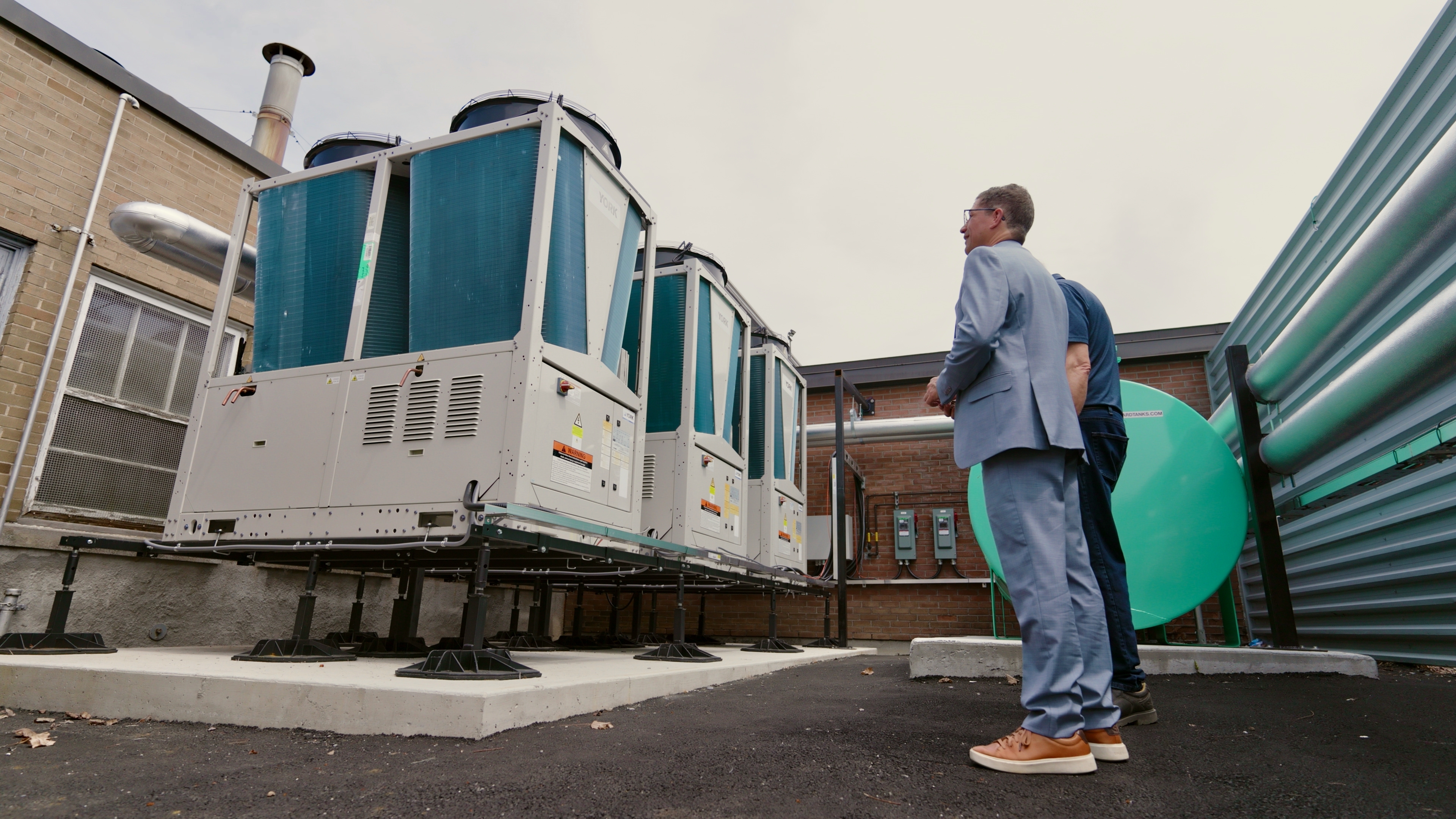
Integration of dual energy for heating the main hot-water loop through the addition of heat pumps and an electric boiler designed to maximize GHG emissions reductions. The heat pumps are used as the first stage of heating and the electric boiler meets the remaining load down to an outdoor temperature of -12 °C. Below this threshold, the system switches to the natural gas boilers.
2- Optimizing the ventilation unit in the Richard wing
Addition of a cold-air duct in parallel with the existing duct to reduce thermal conflict within the unit and optimize control sequences.
3- Recommissioning of mechanical systems (RCx)
This measure will update control sequences and optimize energy use across the College’s mechanical systems.
4- Demand power management
Participation in Hydro-Québec’s demand response (DR) program to optimize operation of the new electric boiler. The boiler is divided into two sections, one connected to the dual-energy meter and the other to the standard meter. This setup makes it possible to combine the benefits of DR and dual energy to optimize every kWh produced by the boiler based on the most advantageous rate at any given time and actual heating needs.
5- Kitchen hood upgrading
Addition of a variable-frequency drive and various sensors to meet actual needs only.
The projected results for all these measures are extremely promising:
- GHG emissions reduction: 87% (-1,186 tCO2e)1
- Reduction in annual energy bill: 12% (-$176,000)1
- Reduction in energy consumption: 37% (-0.45 GJ/m²)1
- ROI period reduction: 16.2 years to 8.5 years
Énergir, your energy project partner
If you’re planning or have implemented a large-scale decarbonization project and would like to optimize its efficiency or learn more about the financial assistance available from Énergir, please contact your Énergir representative or the DATECH team. We’re here to support you throughout the process, help you identify the best solutions and connect you with the most qualified partners when needed.
Legal notice
1. Calculations by Energys are based on hourly energy consumption modelling for each system using operational data collected and energy bills. Comparing this baseline model with projected consumption makes it possible to quantify the energy savings associated with the project.
2. Including the full grant for recommissioning mechanical systems (RCx), part of which will be paid at a later date once all phases of the program have been completed.
Further reading
Maslow’s pyramid applied to energy efficiency in buildings
Every time you take on an energy efficiency project, your challenge is to find the best...
Combined heat and power, a natural gas technology with high potential
Since the 19th century, combined heat and power (CHP) technology has been producing ele...

Change is in the air—with natural gas condensing make-up air units
People are giving more and more attention to the fresh air needs of buildings—they’re c...
Natural gas emergency generators: A reliable and safe alternative
Power outages, natural disasters, fires, business continuity, etc.—the usefulness of em...