
Seniors’ homes (MDA): Energy mix, the preferred solution to meet sustainable development requirements


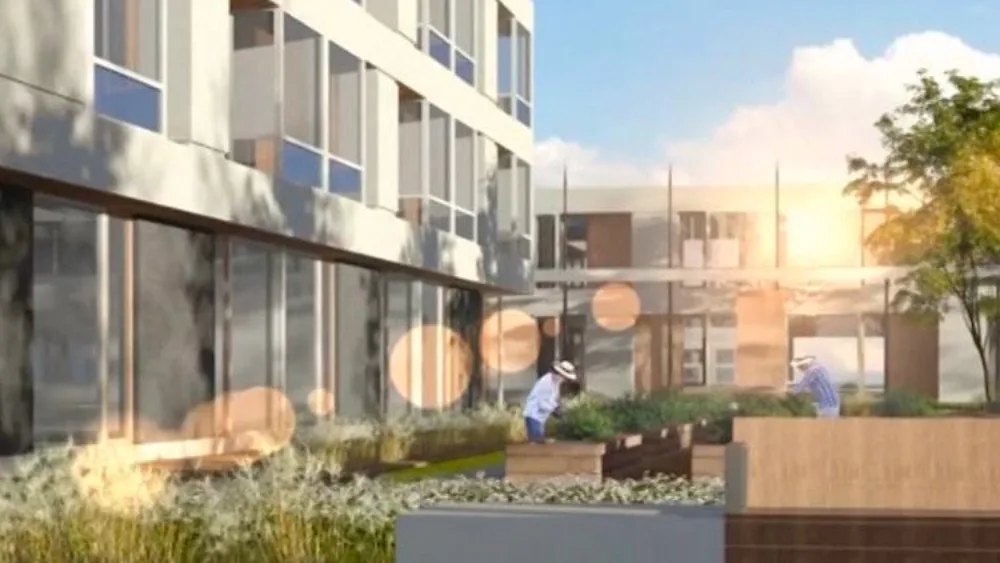
Announced as “a major transformation in housing environments for seniors,” the seniors’ homes project, launched by the Québec government in 2019, has the goal of creating human dimension living environments for seniors with little to moderate autonomy. Divided into modern, friendly “living units,” each accommodating 12 residents, the buildings include between 12 to 192 air-conditioning rooms.
In this ambitious project, the MDAs have to integrate best sustainable development practices, while respecting certain economic imperatives. What are the challenges that the master team (Bouthillette Parizeau) had to meet in this regard? What solutions did it propose and why? That is what we plan to find out in this case study.
Context
Seniors’ homes in a few numbers
- 46 buildings across the province
- Total surface area: approx. 375,000 m2
- 3,468 beds: average 74 beds/building
- 1 GJ/m2 energy consumption for a total of: 375,000 GJ/year
- Construction cost: $1.5 billion
Overview of projects
| Method used | Number of buildings | Number of beds |
|---|---|---|
| Traditional method by master team | 8 | 672 |
| Traditional method | 25 | 1,836 |
| CCF – Conception/Construction/Financing | 13 | 960 |
Mandate
General requirements
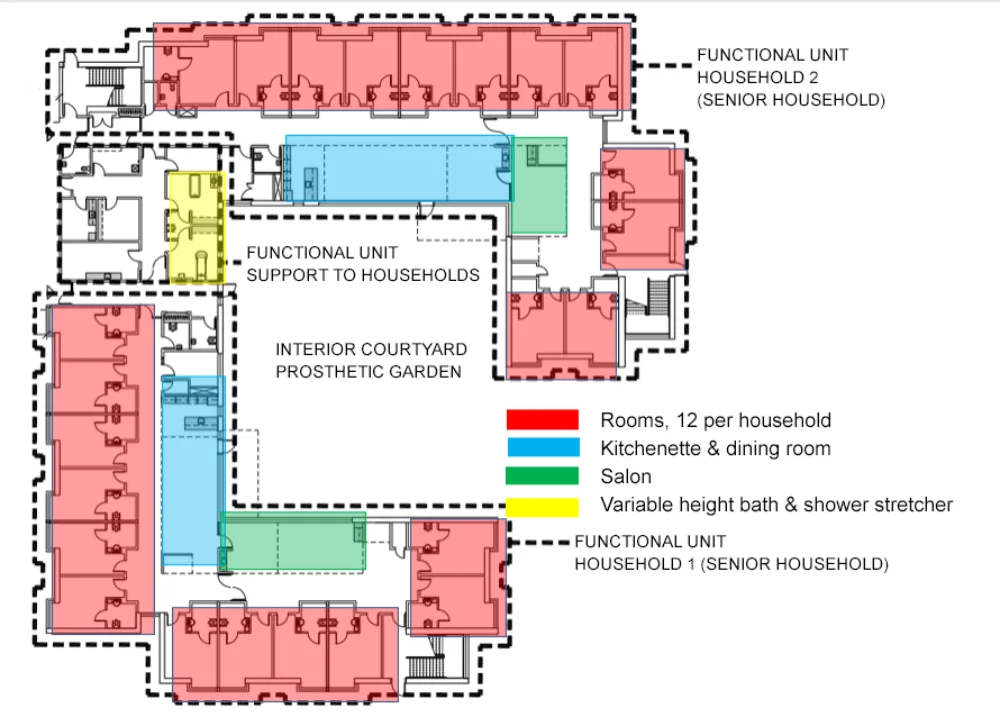
- Create functional 12-room units with dedicated support spaces, as shown below in the layout of a typical floor.
- Respect the latest instructions in the fight against pandemics: each space constitutes a protected bubble thank to ample ventilation.
- Orient the rooms toward a living area to create a dynamic space.
Sustainable development requirements
- Optimize energy efficiency: + 20% above CNEB2011 (ASHRAE 90.1-2010 reference not accepted for demonstrating efficiency).
- Reduce GHGs: Respect criteria 2 & 3 of CCAP 2020, i.e., maximum 20% of fuel used for energy needs, 15% of total consumption.
- Obtain LEEDv4 Certification – Healthcare: The number of points for the Energy and atmosphere credit varies between 10 and 17, depending on the building.
- Respect CSAZ317.2-2015 standard, which includes specific requirements for heating, ventilation, and air-conditioning (HVAC) systems for healthcare facilities.
Solutions
Master team choices
| Category | Choice |
|---|---|
| Lighting | Entirely LED lighting |
| Domestic hot water |
|
| Ventilation |
|
| Heating* |
|
| Chilling |
|
*Heating: Explanation of choices
Select the best energy available at the best cost
In the first drafts, an all-electric strategy was envisaged, but given the requirement for boiler redundancy in case of power outages, huge capacity generators would have been required.
Using gas-fired boilers/water heaters allows an appreciable reduction in the capacity of the generators and an average investment saving of about $4 M compared with the use of 100% electric boilers.
Besides considerably reducing capital costs, natural gas boilers also allow savings in the operating costs of managing electricity peaks.
Optimize peak management
When natural gas is available, gas-fired boilers/water heaters are used to manage electricity peaks, respecting criteria 2 & 3 of CCAP 2020.
Peak management allows a quite significant energy saving of about $5/m2, which translates into an average annual saving of $26,000 for a 48-bed MDA, $40,000 for a 72-bed MDA, and $52,000 for a 96-bed MDA. The saving comes from reducing the monthly peak and removing the applicability of the penalty imposed by Rate M.
Note: This peak management strategy is not used for buildings that use propane because of the high costs of propane compared with natural gas.
Technologies envisaged but not retained
| Technology | Decisions |
|---|---|
| Geothermal | Too many risks are associated with the non-repeatability of the solution, which is dependent on worksite conditions and soil typologies. |
| Aerothermal | Impracticable in a cost-management context. |
| Heat recovery from chillers | Little potential, given the high heat recovery from exhaust air by the heat exchangers, as well as the shape of the buildings. |
Solutions from the concept teams
According to the concept teams, certain variabilities can be observed on the various projects, the most important being:
- 100% outdoor air systems with heat recovery
- Recovery chillers
- Heat recovery on outdoor air with lower efficiencies
- Single duct systems with electric terminal reheat to ensure comfort
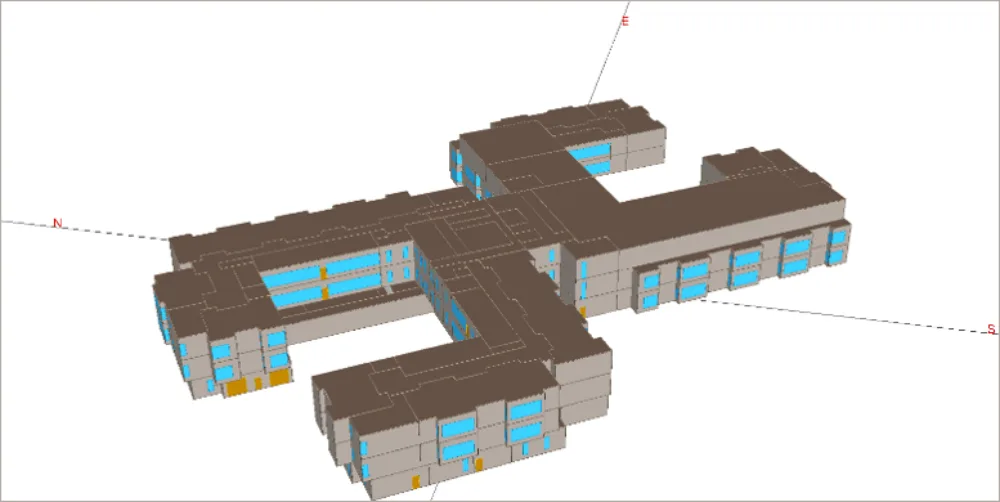
Results for a 96-bed MDA
96-bed MDA configuration
Presentation of results compared with requirements
| Requirements | Objectives | Results or Proposal |
|---|---|---|
| 1. Optimize energy efficiency | 20% more efficient than CNEB2011 | 31% more efficient than CNEB2011 Sources of savings:
See below Table 4 |
| 2. Reduce GHGs | Respect criteria 2 & 3 of CCAP 2020 | See below Table 5 |
| 3. Obtain LEEDv4 certification - Healthcare | Between 10 and 17 points | 17 points LEED v4 – Energy and atmosphere |
| 4. Respect CSAZ317.2-2015 Standard | Respect the particular requirements of healthcare establishments |
|
Table 4 - Sources of energy savings
Proposal | CNEB2011 | |||||
|---|---|---|---|---|---|---|
MJ | MJ | |||||
| Electricity | Natural gas | Total | Electricity | Natural gas | Total | |
| Lighting | 883,843 | - | 883,843 | 2,185,425 | - | 2,185,425 |
| Various equipment | 1,966,040 | - | 1,966,040 | 1,966,040 | - | 1,966,040 |
| Kitchen equipment | 49,926 | - | 49,926 | 49,926 | - | 49,926 |
| Heating | 2,690,698 | 1,001,430 | 3,692,127 | 4,369,629 | 2,635,850 | 7,005,478 |
| Air-conditioning | 883,875 | - | 883,875 | 583,631 | - | 583,631 |
| Pumps | 457,638 | - | 457,638 | 33,084 | - | 33,084 |
| Heat release | - | - | - | - | ||
| Humidification | 367,299 | - | 367,299 | 2,462,185 | - | 2,462,185 |
| Ventilation | 2,582,497 | - | 2,582,497 | 1,247,302 | - | 1,247,302 |
| Domestic hot water | 732,307 | 732,307 | - | 1,392,826 | 1,392,826 | |
| TOTAL | 9,881,815 | 1,733,736 | 11,615,552 | 12,897,222 | 4,028,676 | 16,925,898 |
| Energy savings | 31% | |||||
| COSTS | $202,884 | $19,182 | $222,066 | $334,888 | $41,793 | $376,681 |
| Cost savings | 41% | |||||
| Statistics | Proposal | CNEB2011 |
|---|---|---|
| Surface area - m2 | 10,493 | |
| GJ/m2 | 1,11 | 1,61 |
| kWh/pi2 | 29,22 | 42,58 |
| Average cost - $/kWh | 0,074 | 0,093 |
| Average cost - $/m3 | 0,42 | 0,39 |
Table 5 - Goals related to CCAP 2020 (to be removed from table)
| Objectives related to CCAP 2020 | Proposal | Objectifs |
|---|---|---|
| % of energy needs for heating met by fuel | 11,8% | < 20% |
| % of fuel consumption compared with building's total energy consumption | 14,9% | < 15% |
Role of Énergir in this project
Énergir participated in the MDA project by supporting the master team in seeking solutions that optimally meet requirements while maximizing the amount of financial assistance available. This collaboration led, in particular, to grants averaging $70,000 for 96-bed MDAs under the New efficient construction program.
Conclusion
Given a context that called for reconciling energy savings and costs, reducing GHG, and ensuring the comfort of the users, the energy mix (the right energy in the right place at the right time) turned out to be the most viable solution for the seniors’ homes. While the choice of technologies may vary according to the local setting, the combined and complementary use of natural gas and electricity will enable delivering MDAs that comply in all respects to government requirements. To date, 34 of the 46 MDAs announced are already under construction, and the large majority should be delivered by Fall 2022.
Nathalie Boulet, Eng., CEM CEA Leed C+CB
Project Manager,
Bouthillette Parizeau
Sami Maksoud, Eng., M. Eng., MBA, CMVP®
Advisor, Energy Efficiency, DATECH
Énergir
Further reading

How Dual Energy Can Make a Difference in Commercial, Institutional and Multi-unit Rental Buildings
Since November 6, Énergir, in conjunction with Hydro-Québec and Écoperformance, has bee...
Evaluation of techno-economic potential of producing renewable natural gas in Québec
Climate change has already had an impact on our modern lives. Developing energies and t...

Renewable natural gas, a circular economy model
Renewable natural gas production not only presents a significant economic development p...

The recommissioning of building mechanical systems: A simple and cost-effective way of reducing operating costs and GHG emissions from commercial buildings
In property management, energy expenses are the line item with the greatest potential f...